In 1913, women’s boxing lived a double life. Even as women laced up gloves in local gyms, vaudeville theaters, and street protests, official sports organizations were busy slamming the door on them. “While women were visibly stepping into gymnasiums, theater stages, and political rallies with gloved hands, the mainstream sporting world was actively closing its doors to them. Because official athletic commissions barred female competitors from sanctioned prize fights, the history of women’s boxing in 1913 is not a story of stadium bouts or official championship belts—it is a story of institutional exclusion, vaudeville resilience, and militant self-defense.
By 1913, boxing was undergoing rapid formalization across Europe and North America, yet this modernization deliberately left women behind. National governing bodies were establishing strict rules modeled after the English Marquess of Queensberry regulations, defining boxing an exclusively male domain.
A prime example occurred in 1913 with the founding of the Swiss Boxing Association (SBV). Like its counterparts across the continent, the association explicitly excluded women from competition. National sports federations were aligning closely with the International Olympic Committee—which had only recognized men’s boxing—and state institutions such as the military and police. Within this framework, boxing was promoted as a tool for masculine discipline and national defense, leaving no official room for female boxer. As documented by the Women Boxing Archive Network (WBAN), the years between the 1904 Olympic demonstration in St. Louis and the post-World War I boom of the 1920s became a quiet period in formal records, largely because mainstream sports journalists refused to cover female fighters seriously.
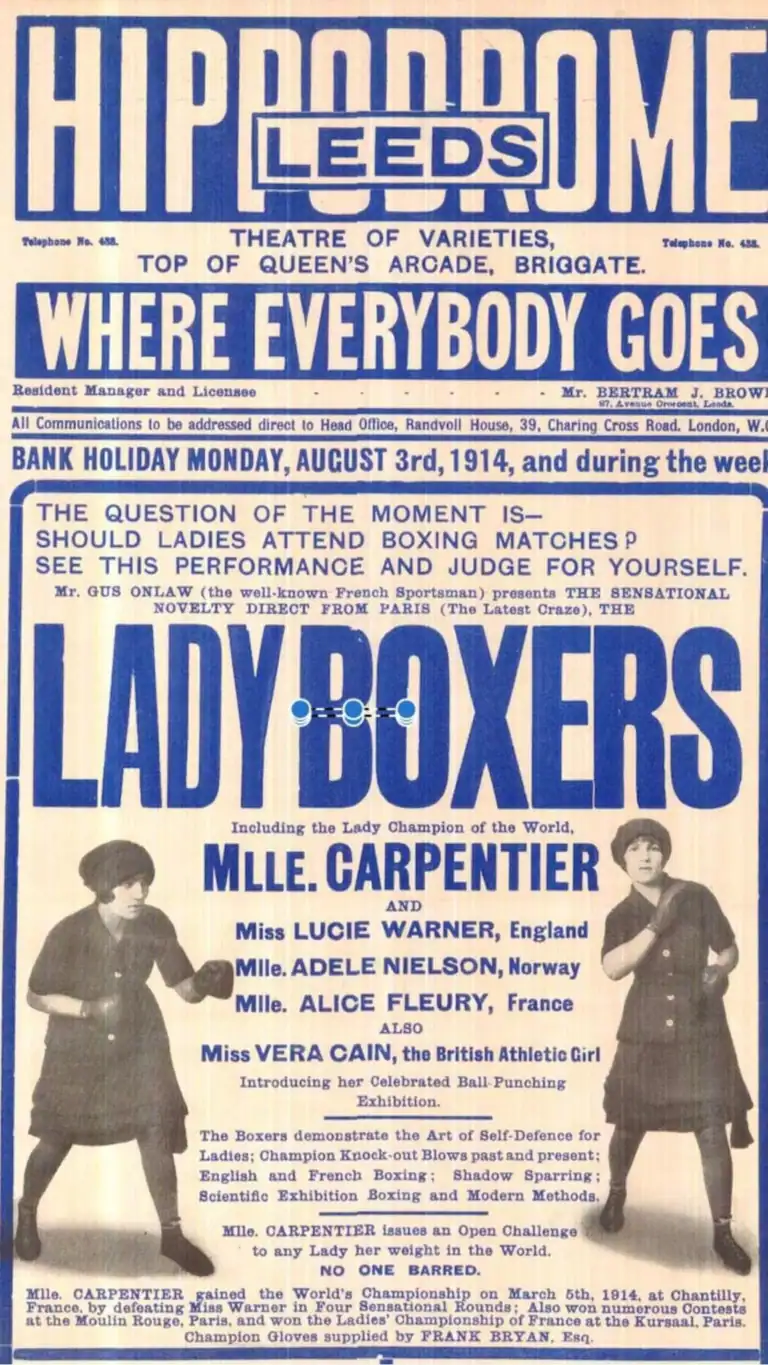
When female boxers were shut out of sanctioned arenas, they found a home in entertainment and fitness. Throughout 1913, women who wanted to box publicly turned to the vaudeville stage, music halls, and traveling fairground booths.
To bypass municipal bans on female prize fighting, these bouts were frequently billed as “scientific sparring demonstrations” or displays of “physical culture”—the early 20th-century movement emphasizing health, calisthenics, and bodily strength.
In private gymnasiums across cities like Berlin, London, and New York, women trained in bloomers and soft-soled gym shoes, practicing footwork and bag work under the banner of personal fitness rather than competitive sport.
Perhaps the most urgent application of women’s boxing in 1913 took place far outside the entertainment industry. In the United Kingdom, the campaign for women’s voting rights reached a fever pitch in 1913, marked by mass demonstrations, arrests, and fierce clashes with police and hecklers.
Members of the militant Women’s Social and Political Union (WSPU) actively took up boxing alongside jiu-jitsu as practical self-defense. At private London training clubs—most famously the “Suffragette Dojo” run by Edith Garrud—women learned how to throw a punch, block blows, and protect movement leaders during street protests. For these women, boxing was not a novelty or a pastime; it was a necessary skill for physical survival on the political frontlines.
Despite the lack of formal sanctioning bodies, several determined women carved out careers in boxing, exhibition fighting, and self-defense instruction around 1913:
- Polly Fairclough (Polly Burns): Born into a Lancashire circus and fighting family in 1881, Fairclough was one of the most formidable British female fighters of the era. Beginning her career at age 16 in traveling fairground booths, she regularly boxed and wrestled men for prize money. In 1913, she made history as the first woman to compete inside London’s prestigious National Sporting Club, sparring with former world heavyweight champion Tommy Burns, whom she later married. Barbara Buttrick gives credit for reading about Polly Burns one day as a young person that inspired her to box!
- The Bennett Sisters (Crystal, Lura, and Sister): Between 1910 and 1915, the American trio known as the Bennett Sisters toured the U.S. vaudeville circuit, blending athletic combat with theatrical entertainment. Wearing padded shorts and oversized gloves, they boxed, wrestled, and fenced one another on theater stages across the country. Crystal Bennett even billed herself as the “Lightweight Champion” in 1910 to draw crowds and legitimize their athletic prowess.
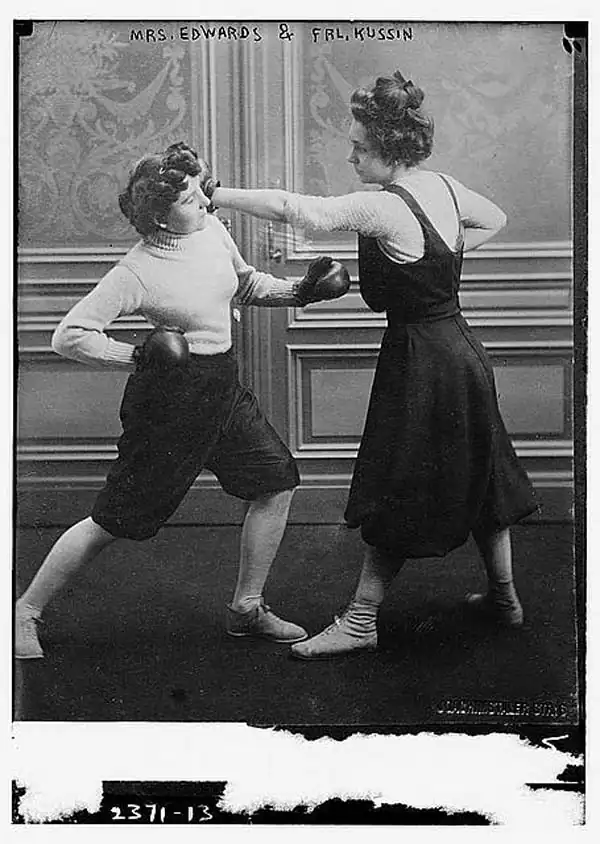
- Rose Edwards: Based in Berlin, Rose Edwards was a prominent figure in early German physical culture and instructional boxing. Married to German welterweight boxer Paul Maschke (who fought under the alias “Joe Edwards”), Rose helped teach at her husband’s Berlin boxing school. Her 1912 sparring photographs with fellow boxer Fräulein Kussin—created as instructional illustrations for Joe Edwards’ boxing manual—became some of the most widely circulated images of female boxers in the early 1910s.
Edith Garrud: While best known as the suffragette movement’s pioneering jiu-jitsu instructor, Garrud was a central figure in women’s combat training in 1913 London. Operating out of her Golden Square dojo, she trained the WSPU’s all-female “Bodyguard” unit in close-quarters combat—combining jiu-jitsu throws, Indian club defense, and basic boxing strikes—to shield Emmeline Pankhurst and other suffrage leaders from violent arrests during 1913 rallies.
Lastly, in 1913, a woman stepping into a boxing ring faced legal hurdles, social ridicule, and complete erasure from official record books. Yet by keeping the sport alive through theatrical exhibitions, physical culture clubs, and suffrage self-defense classes, these pioneers preserved a foothold in the ring—laying the groundwork for the surge in women’s boxing during the Roaring Twenties and, eventually, its recognition as an Olympic sport nearly a century later.
About the Author