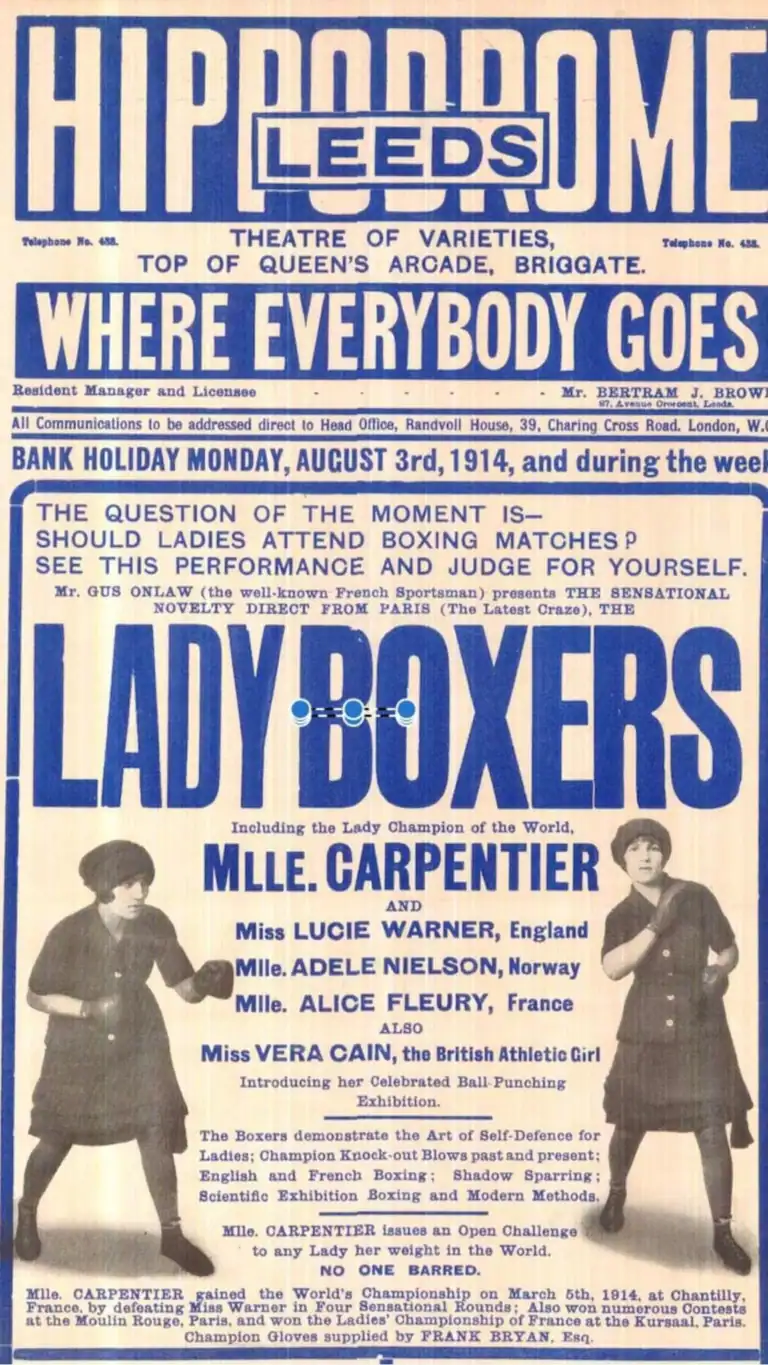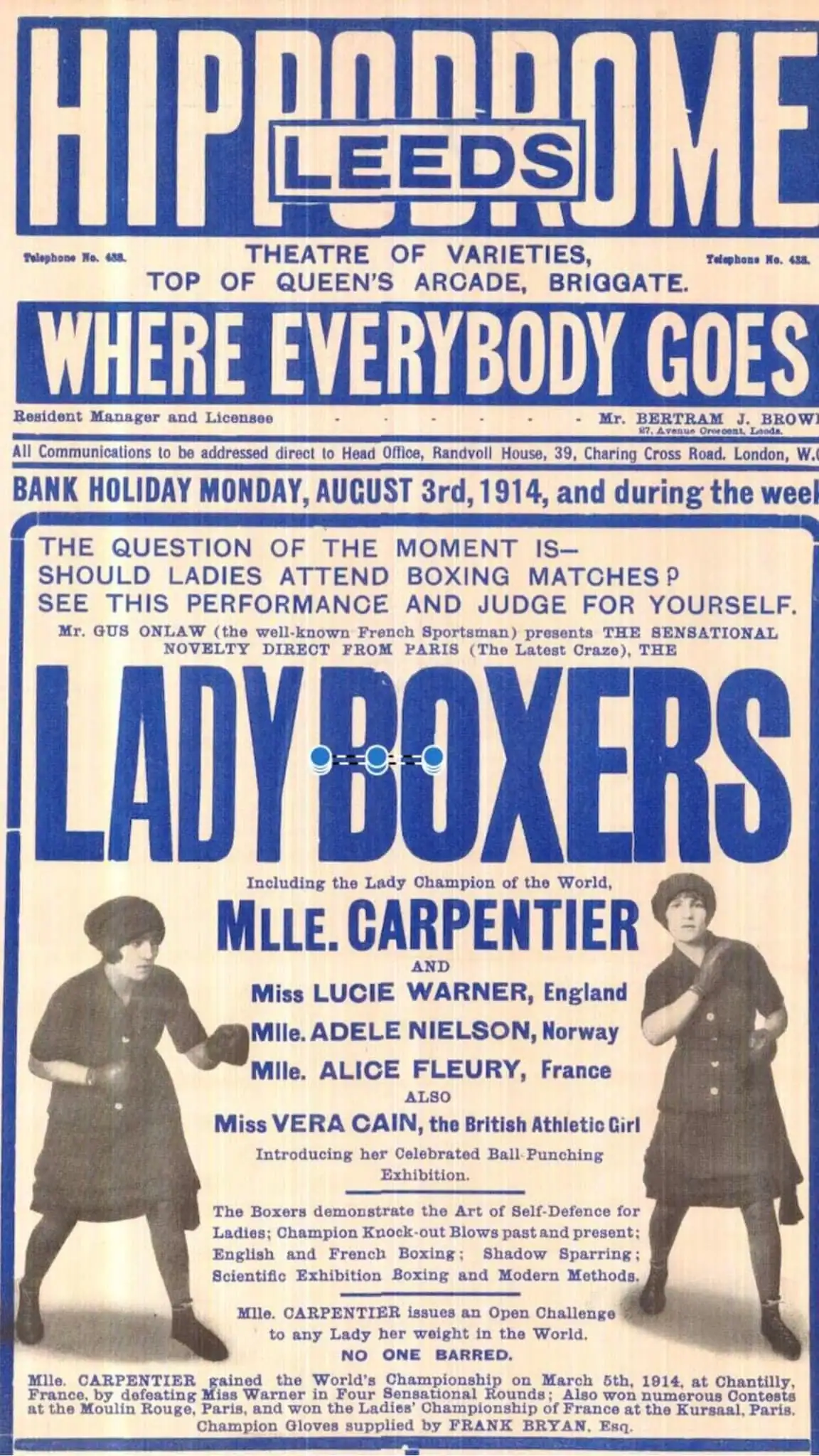
Long before modern women’s boxing made its Olympic debut in 2012, female prizefighters were stepping into the ring before packed audiences across Britain. An original theater broadside from the Leeds Hippodrome—dated Bank Holiday Monday, August 3, 1914—captures the birth of professional women’s pugilism on the literal last day of European peace before World War I.
The “Lady Boxers” Arrive in Leeds
Operated by the Variety Theatres Controlling Company, Ltd., and managed by resident licensee Bertram J. Brown, the Leeds Hippodrome stood at the top of Queen’s Arcade on Briggate in the heart of Yorkshire’s industrial capital. For the August Bank Holiday week of 1914, impresario Gus Onlaw brought his touring international troupe to the stage: “THE SENSATIONAL NOVELTY DIRECT FROM PARIS (The Latest Craze), THE LADY BOXERS.”
The bill featured an international five-woman lineup led by France’s Mlle. Marthe Carpentier (born in 1893 and sharing no relation to French heavyweight idol Georges Carpentier), billed as “the Lady Champion of the World.” Alongside her appeared English rival Miss Lucie Warner, Norway’s Mlle. Adele Nielsen, France’s Mlle. Alice Fleury, and Miss Vera Cain, billed as “the British Athletic Girl,” who performed solo calisthenics and speed-bag (“ball-punching”) exhibitions.
Navigating Edwardian Morality and Law
Every line of promotional copy on the poster reflects how carefully promoters navigated Edwardian gender politics and local censorship laws. Under the provocative headline—“THE QUESTION OF THE MOMENT IS—SHOULD LADIES ATTEND BOXING MATCHES? SEE THIS PERFORMANCE AND JUDGE FOR YOURSELF”—the theater invited middle-class women to buy tickets under the guise of an educational civic debate.
To protect the venue from magistrate bans on female prizefighting, the bouts were framed as “Scientific Exhibition Boxing” and “the Art of Self-Defence for Ladies”—a direct nod to the British suffragette movement, whose members actively trained in boxing and jujitsu. At the same time, the poster reassured sporting purists of the show’s authenticity, noting that champion gloves were supplied by renowned London leather-goods maker Frank Bryan, Esq., and highlighting Carpentier’s March 1914 victory over Lucie Warner in Chantilly, France, as well as her bouts at the Moulin Rouge and the Kursaal.
Bank Holiday Monday, August 3, 1914: The Final Curtain of Peace
What elevates the Leeds Hippodrome poster from rare sporting ephemera into a poignant World War I artifact is its date. Under Britain’s Bank Holidays Act, the first Monday in August was a statutory summer holiday. Across Leeds, thousands of mill workers and engineers strolled down Briggate in warm sunshine, buying tickets for the Hippodrome’s twice-nightly performances.
Yet behind the scenes, Europe was collapsing into total war. Earlier that afternoon in London, Chancellor of the Exchequer David Lloyd George secured an emergency extension of the August 3 Bank Holiday through August 6—creating the longest Bank Holiday in British history—to halt a financial panic and print emergency paper currency. At 6:00 PM that evening, Germany declared war on France and issued an ultimatum to neutral Belgium. As audiences filed into the Leeds Hippodrome to watch Marthe Carpentier and Lucie Warner step into the ring, British Foreign Secretary Sir Edward Grey stood at his Whitehall window watching the streetlamps being lit and famously remarked, “The lamps are going out all over Europe, we shall not see them lit again in our life-time.”
The very next day, August 4, Germany invaded Belgium, and Great Britain entered World War I. Within weeks, wartime mobilization emptied European sports halls as male champions enlisted for the front. Paradoxically, the conflict accelerated the acceptance of women’s boxing in Britain: by 1915, as millions of men left for the trenches, British newspapers praised the touring “Lady Boxers” as proof that women could step boldly into traditionally male physical roles on the home front.
Image Caption: Original Leeds Hippodrome variety poster advertising Mlle. Marthe Carpentier and the “Lady Boxers” for the week beginning Bank Holiday Monday, August 3, 1914—the day Germany declared war on France and the eve of Britain’s entry into World War I. (Author’s collection / Public Domain)
About the Author